
AI-First: The 5 Hard Truths Business Owners Learn Too Late
The allure of an “AI-First” business is undeniable. Promises of unprecedented efficiency, hyper-personalized customer experiences, and exponential growth fuel a stampede towards integrating artificial intelligence into every facet of operations. Global AI spending is a testament to this enthusiasm, nearly doubling from $154 billion in 2023 to $279 billion in 2024, with projections indicating a tripling again by 2026 [Global Data & Trends, 2026]. However, beneath the surface of innovation lies a landscape fraught with challenges. Many business owners, caught in the initial excitement, learn critical lessons only after significant investment and operational disruption. This article uncovers five hard truths about the AI-First journey that are often discovered too late.
Defining the “AI-First Leap”: More Than Just Adopting Tools
Transitioning to an AI-First model signifies a fundamental strategic shift, not merely the adoption of new Software as a Service (SaaS) tools. It means re-imagining core business processes, customer interactions, and operational workflows with AI technology as the primary driver, rather than an add-on. This leap involves rethinking how information is gathered, processed, and acted upon. It’s about embedding intelligence into decision-making at every level, from product development to customer support. An AI-First approach fundamentally differs from simply adopting AI tools; it re-imagines the business with AI as the central operational driver, not an external add-on.
The Value of Hindsight: Avoiding Costly Mistakes
The rapid evolution of AI models, from basic automation to sophisticated generative AI capabilities like OpenAI’s GPT series, Llama 3, and Claude, creates a dynamic environment where staying ahead requires constant adaptation. Businesses must keep adapting to stay ahead, as AI tools are changing quickly, ranging from simple automation to advanced models [Stanford HAI, 2025]. Yet, many businesses chase the latest AI capabilities without a clear strategic roadmap, leading to costly missteps. Many business owners get excited at first and learn important lessons only after spending a lot and facing problems in operations [The Motley Fool, 2024]. The insights gained from those who have navigated this path reveal common pitfalls that, if addressed proactively, can prevent significant setbacks. Learning these lessons early is paramount for sustainable AI-First growth.
Lesson 1: Don’t Just Build with AI, Build FOR the Customer (Not the Tech)
The most profound mistake business owners make is falling in love with the technology itself. The temptation to deploy cutting-edge AI models for the sake of having them, rather than for their ability to solve a genuine customer problem, is pervasive. This leads to products and services that are technically impressive but fail to resonate with the market.
The Illusion of the “Technologically Superior” Product
A business might invest heavily in advanced generative AI capabilities for a product feature, only to find that customers do not need or understand its value. The “wow” factor of these advanced capabilities can obscure the fundamental need for a product to serve a clear customer purpose. This technological focus can lead to a disconnect between the product and market demands, ultimately hindering adoption and growth. The excitement about new technology must be balanced with a strong focus on customer value, a solid data base, realistic money planning, and helping employees grow.
Prioritizing Customer Discovery Over AI Feature Hype
True AI-First success stems from a deep understanding of customer needs and pain points. This requires rigorous customer discovery interviews, market research, and continuous feedback loops. Instead of asking “What can AI do?”, the question should be “What problem can AI help us solve for our customer?” Businesses should use direct customer feedback to add AI to customer support, personalize emails, and improve product features. This helps the business meet customers’ changing needs [Salesmate, 2026]. Integrating AI into inventory management can be revolutionary, but only if the underlying business processes and customer needs are understood. This validation is often best achieved through minimum viable products (MVPs) that demonstrate tangible value before significant investment.
Lesson 2: Your Data is Your AI’s Foundation – Or Its Fatal Flaw
AI models are only as good as the data they are trained on. Many businesses rush into AI integration without adequately preparing their data infrastructure, leading to flawed outputs and wasted investment. The notion of “garbage in, garbage out” is amplified in an AI-First context.
The Unprepared Data Disaster: The Hidden Cost of Neglect
Data silos, poor data quality, and a lack of proper data governance create an environment ripe for AI failure. Businesses that do not invest in robust data collection, cleaning, and organization from the outset will find their AI models producing inaccurate or biased results. This can lead to incorrect business decisions, damaged customer relationships, and significant remediation costs down the line. The operational overhead of fixing data issues after AI integration can be astronomical. Furthermore, 45% of companies cite concerns about data accuracy or bias as a major AI adoption challenge in 2025 [IBM, 2025].
Investing in the Right Data Infrastructure from Day One
A proactive approach involves building a solid data foundation before deploying AI models. This includes establishing clear data pipelines, implementing data quality checks, and ensuring compliance with privacy regulations. Whether using internal data or third-party information, its integrity is paramount. The capabilities of generative AI, while impressive, are severely limited by the quality and accessibility of the underlying information. This means investing in robust storage infrastructure and ensuring data engineers are part of the initial planning. Platforms like AI Studio can help manage AI development, but the core data infrastructure must be sound. Organizations must also be acutely aware of security issues and online threats that target data, including protecting sensitive IP addresses. While cloud storage solutions like Google Drive or Microsoft 365 are useful for general data organization, they are insufficient for the rigorous demands of AI-ready data preparation.
Lesson 3: The Unforeseen Costs and Operational Realities of AI-First Integration
The initial investment in AI software licenses and API calls is often just the tip of the iceberg. Business owners frequently underestimate the broader financial and operational implications of a true AI-First transformation.
Budgeting for the Invisible: Beyond Software Licenses and API Calls
Beyond the direct costs of AI models from vendors like OpenAI or Claude, businesses must account for significant expenses related to compute power, ongoing model training and fine-tuning, infrastructure requirements, and specialized talent. Besides the direct costs of AI models from companies like OpenAI or Claude, businesses must pay for computer power, ongoing training and tuning of models, maintaining infrastructure, and hiring skilled workers [Salesmate, 2026]. This includes services like AWS EC2 for processing power. Furthermore, the cost of potential cybersecurity breaches in AI systems, often overlooked, can be devastating. The economics of advanced AI models, including those like Llama 3 or the potential of Llama 4 Maverick, extend far beyond their API access, requiring substantial investment in infrastructure requirements, particularly for storage infrastructure and processing power. For AI startups seeking a VC round or funding from angel investors, accurately projecting these ongoing costs is critical for financial viability.
Operational Overhaul: Redefining Workflows, Not Just Automating Tasks
An AI-First business requires a fundamental re-architecting of operational workflows. It’s not about automating existing tasks but about reimagining how work gets done. This might involve adopting new Software as a Service (SaaS) platforms, integrating AI agents, or even restructuring teams. Many organizations fail to allocate sufficient resources or strategic planning for this operational shift, viewing AI as merely a tool to optimize current processes rather than a catalyst for profound change. Business owners often do not realize the full financial and operational effects of a true AI-First change. This necessitates re-defining standard operating procedures to align with AI-driven processes, which can be a significant undertaking.
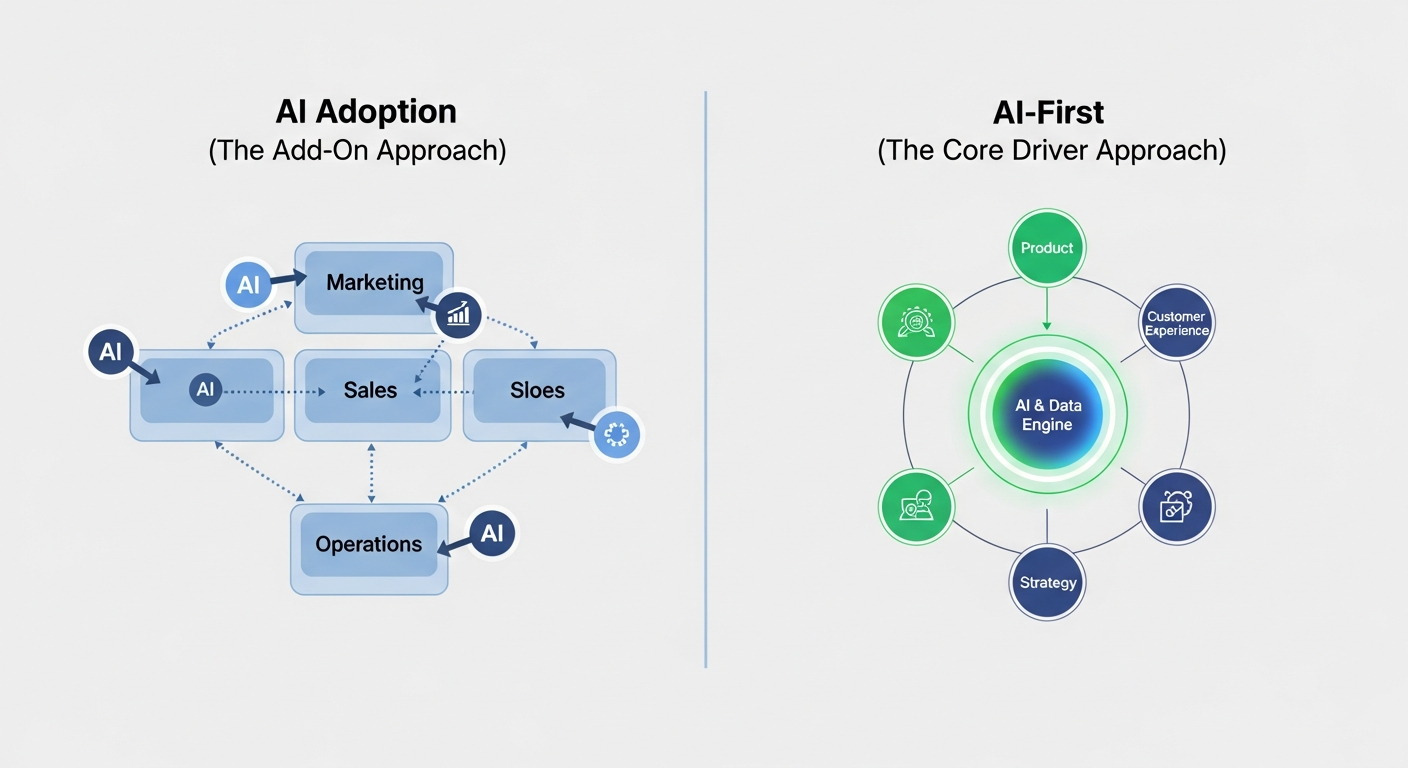 An AI-First strategy fundamentally re-architects the business around a central intelligence core, unlike a traditional model where AI tools are simply added to existing processes.
Lesson 4: The Human Heart of the Machine: Empowering Your Team in an AI-First World
The most advanced AI models are ineffective without a skilled and engaged workforce. Overlooking the human element is a critical mistake that hinders AI adoption and its potential benefits.
Overcoming Employee Resistance and Bridging Skill Gaps
Many surveyed leaders identify insufficient worker skills as the biggest barrier to integrating AI into existing workflows [Deloitte US, 2026]. The rapid pace of change means that skills for AI-exposed jobs are evolving 66% faster than for other jobs [PwC, 2025]. Businesses must proactively address employee resistance through clear communication, training, and demonstrating how AI can augment, not just replace, human capabilities. Over 90 percent of global enterprises are projected to face critical AI skills shortages by 2026, risking substantial losses if not addressed [Workera, 2026]. This highlights the crucial need for comprehensive employee training and establishing a robust support network to help employees adapt.
Cultivating the AI-Empowered Workforce
Fostering an AI-literate culture is essential. This involves investing in continuous learning, encouraging experimentation, and creating an environment where employees feel empowered to work alongside AI. Task-specific AI agents are becoming increasingly common, with Gartner forecasting that 40% of enterprise applications will embed them by 2026 [Salesmate, 2026]. Equipping your team to leverage these tools is paramount for maximizing their impact. Institutions like Stanford Seed, the Wharton School, and the Stanford Graduate School of Business emphasize the importance of organizational change and human capital development in innovation adoption. A strong internal support network and effective change management strategies are crucial for successfully integrating AI into daily operations and redefining standard operating procedures. Companies like Fastech Solutions can offer insights into managing these human-centric aspects of AI implementation.
Lesson 5: Funding, Finances, and the AI-First Cash Flow Reality
The financial model for an AI-First business often differs significantly from traditional models. Underestimating these differences can lead to cash flow crises and investor disillusionment.
The VC Round Illusion: Attracting Smart Investment, Not Just Money
Securing venture capital investment is often seen as validation, but the pursuit of funding can distract from building a sustainable business model. Investors are increasingly scrutinizing the AI strategy and projected ROI. Businesses need to articulate a clear path to profitability that accounts for the ongoing costs of AI development and maintenance, not just the initial product launch. For AI startups, demonstrating a clear understanding of the financial landscape, including a solid cashflow analysis, is as crucial as the technology itself. Attracting a VC round or angel investors requires not just a good idea, but a viable financial roadmap that accounts for perpetual AI investment.
Beyond the Burn Rate: Sustainable Financial Models for AI-First Businesses
AI-First companies must develop financial models that account for the perpetual investment required for AI evolution. This includes licensing fees for advanced AI models, data infrastructure costs, and the talent required to manage and innovate. A clear understanding of cash flow, vendor relationships, and market positioning is crucial for long-term viability. Focusing solely on rapid growth without a sound financial strategy can lead to an unsustainable burn rate. A thorough cashflow analysis is vital, ensuring that investments in AI, such as those leveraging retrieval augmented generation or advanced AI models, contribute positively to the bottom line. The focus should be on building sustainable Software as a Service (SaaS) models underpinned by AI, rather than just technological novelty.
Lesson 6: Security and Ethics: The Non-Negotiables of AI-First Design
In an era of increasing digital threats and ethical scrutiny, cybersecurity and ethical considerations are not afterthoughts but foundational requirements for any AI-First business.
The Hard Truth About Online Threats and Data Breaches in AI Systems
AI systems, by their nature, handle vast amounts of sensitive information, making them prime targets for cyberattacks. Prompt injection, data poisoning, and sophisticated breaches pose significant risks. Because digital threats and ethical concerns are growing, cybersecurity and ethics must be basic parts of any AI-First business. They cannot be afterthoughts. A data breach can lead to severe financial penalties, reputational damage, and a complete loss of customer trust. Robust cybersecurity measures must be integrated into the core AI architecture from the design phase, protecting everything from IP addresses to proprietary algorithms developed on platforms like Meta AI.
Navigating the Regulatory Minefield and Ethical Imperatives
Beyond security, businesses must grapple with the ethical implications of AI, including bias in AI models, transparency in decision-making, and responsible use of data. Evolving regulations around AI necessitate a proactive approach to compliance. Companies that fail to address these ethical and regulatory challenges early on risk facing legal repercussions and public backlash, undermining their AI-First aspirations. This includes being mindful of potential issues related to AI glasses and AR glasses, ensuring their deployment is ethical and secure. Implementing AI responsibly often involves using retrieval augmented generation to ensure AI responses are grounded in verifiable, ethical data sources, and employing AI Studio for controlled development and testing.
Conclusion: The AI-First Advantage – A Path Forged by Lessons Learned
Embracing an AI-First strategy offers immense potential for business transformation and growth. However, the journey is paved with hard-won lessons that many discover too late. The allure of technological advancement must be tempered by a relentless focus on customer value, a robust data foundation, realistic financial planning, and a commitment to empowering the human workforce.
Summarizing the Critical Takeaways
The five hard truths highlight the critical need to: prioritize customer needs over technology hype, build on a solid data infrastructure, meticulously budget for unforeseen operational costs, invest in employee upskilling, and integrate security and ethics from the outset. Ignoring these principles can transform the promise of AI into a significant business liability. The five hard truths show the need to focus on customer needs instead of technology hype. They also show the need to build a strong data system, carefully plan for unexpected costs, train employees, and include security and ethics from the start.
Forging a Future with AI: Proactive, Adaptive, and Human-Centric
Ultimately, the AI-First advantage is realized not by simply adopting AI tools, but by developing a proactive, adaptive, and human-centric strategic mindset. Businesses that learn from these common pitfalls and build their AI journey on a foundation of genuine customer understanding, robust data, financial prudence, and empowered people will not only survive but thrive in the AI-driven future. This requires a continuous commitment to learning, iteration, and strategic foresight, ensuring that AI serves as a true catalyst for sustainable business growth. Such a future might even involve novel interfaces like AI glasses or AR glasses, but their successful integration hinges on mastering these fundamental business principles.


0 Comments